

Plainsman Clays | H441G
H441G High Fire Clay
$33.92 / 20 kg (44 lb) Pugged
$33.92
Suggested retail price. In-store prices and availability may vary by location.
High fired, White-buff burning, Grogged, Medium textured, Plastic, Non-vitreous, Sculpture and Hand-building clay body
Specifications
Type
High temperature sculpture body · white-buff burning · grogged · non-vitreous
Texture
Medium textured · plastic
Usage
Sculpture · hand-building · overhung and unsupported forms · reduction firing · throwing
Temperature
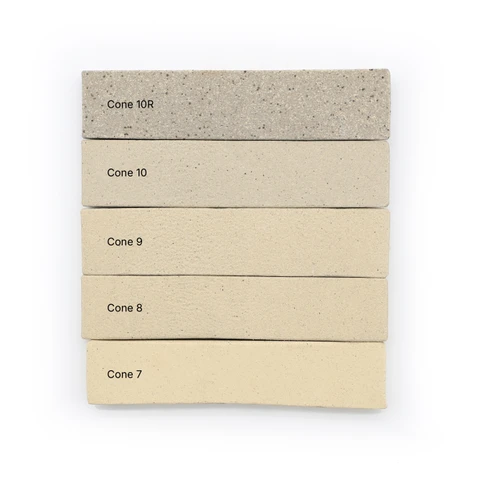
Cone 9 · 10 · 10R – we recommend cone 10 reduction (cone 10 = 1285 °C / 2345 °F). H441G fires from cone 8 to cone 11 in oxidation, and at cone 10 in reduction.
Colour
Light white-buff in oxidation, and very stable from cone 8 through 11 · much the same in reduction, with grey patching and a scattered iron speckle
Shrinkage
Dry 5.0–6.0% · fired 4.3–4.5% at cone 9, 4.5–4.8% at cone 10, 4.6–4.9% at cone 10 reduction
Absorption
Cone 9 9.2–9.5% · cone 10 8.5–8.7% · cone 10 reduction 8.2–8.3%
Every figure is a measured range from the Plainsman lab, not a single nominal number. Cone equivalents are Orton self-supporting cones at 108 °F/hr.
Description
H441G is the most refractory clay body we make, and it is built for sculpture and hand-built work rather than for functional ware. It is grogged, with a medium texture: the base clay masks much of the grog, so it is easier on the hands than H440G, our darker-firing grogged body.
Staying porous is the point of it. A body that does not vitrify holds its shape in the kiln, which is what lets you fire overhangs, appendages and shapes that have little strength of their own without them slumping or warping.
Grog earns its place during both drying and firing: it helps moisture escape from thick walls more effectively than a smooth body, reduces drying shrinkage, and prevents emerging cracks from spreading through the piece.
Working properties
- Plastic, with a medium texture, and it throws well for a grogged body.
- Keep the water down on the surface. Grogged bodies are prone to water splitting: water left standing on plastic clay can start a split that spreads, and on a large piece that can bring the whole form down.
- The grog helps a join heal. Use a low-water-content slip, apply as much pressure as you can, and move the two surfaces laterally against each other so the slip takes hold.
- Thick work, and anything of uneven thickness, needs extra drying time under cloth and plastic.
- Do the final drying under heat to drive off all the water, and preheat the kiln overnight on low. This matters most in an electric kiln, which has no draft of its own.
Fired colour & cone behaviour
- Light white-buff in oxidation, and the colour is very stable right across cone 8 to cone 11.
- At cone 10 reduction it reads much the same, with grey patches where microscopic areas begin to vitrify, and an iron speckle scattered through it. Soluble salts bring some surface discolouration, which picks out texture and contour on unglazed reduction-fired work.
- Fire large sculptural forms on a thick slab of the same clay. The slab takes up the shrinkage stress and reduces cracking and warping.
- For work going outdoors, seal the pores against water with a concrete or brick sealant, or freeze and thaw will get into them.
Glazes & glaze fit
- The light reduction colour does not pull glazes or colours about, so a glaze reads close to true on this body.
- Iron stone concretions can melt in a high-temperature reduction firing and bleed up through a glaze as iron blossoms. How much speckle you get varies from firing to firing.
- Slips and oxides suit H441G well, particularly over an altered or treated surface. Match the slip’s drying and firing shrinkage to the body.
- H441G is not recommended for functional ware. It is refractory, and it stays porous.
Chemical analysis
LOI 9.6%