




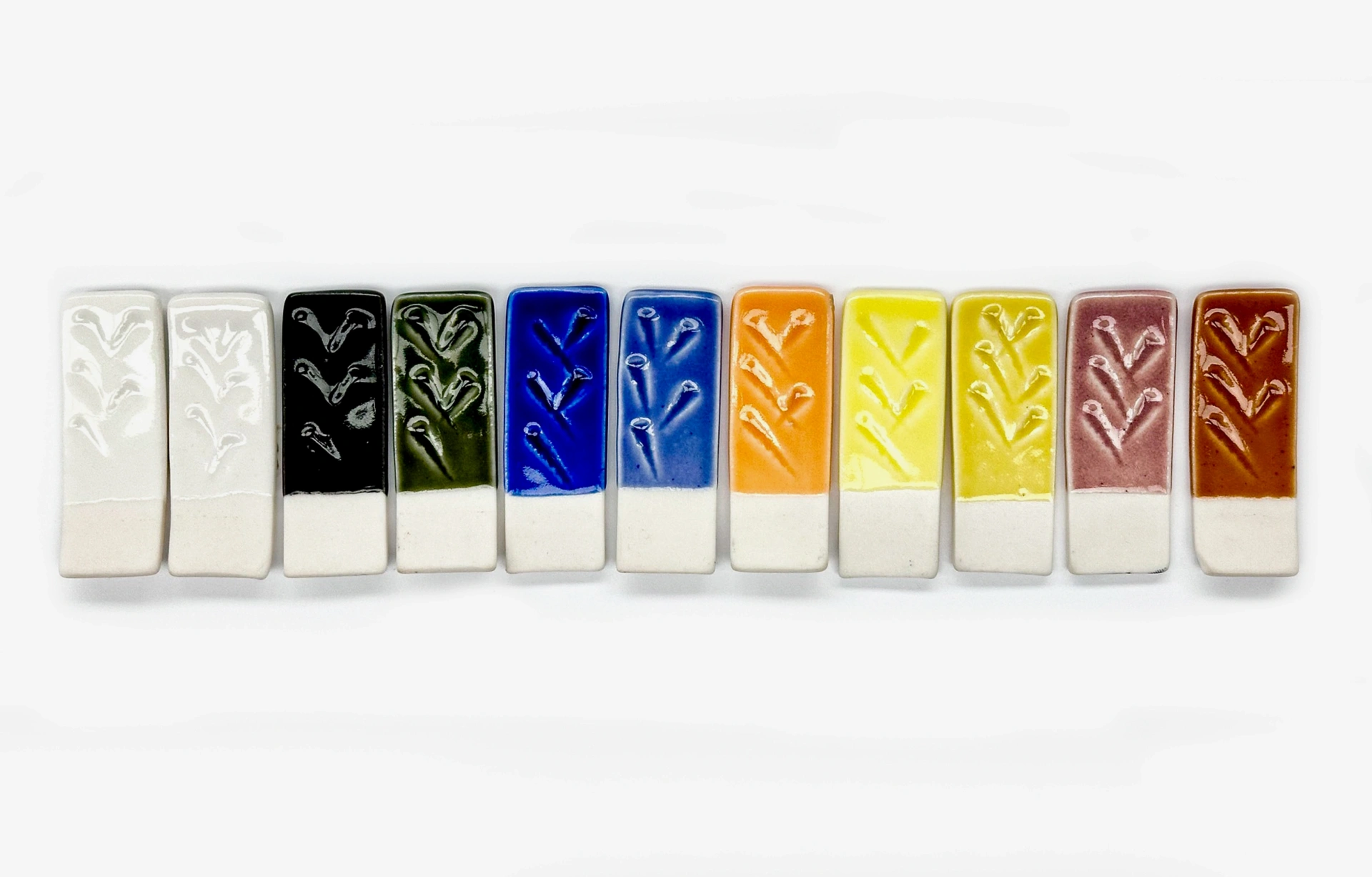
Have you wanted to try a dipping glaze but are not sure where to start? Perhaps you simply want a medium-fire glaze and do not want to deal with the mess of measuring and buying all the individual ingredients. Plainsman transparent glossy and matte dipping glazes offer a solution. Both glazes are sold as dry powder in either 2.5 kg or 44 kg bags.
Glossy Glaze
The glossy glaze is designed to fit Plainsman Clays M370. It is a low-expansion, medium-fire transparent glaze that can be used as a liner glaze. It also fits M340, Wheat, and Polar Ice. On red, high-iron stoneware clays, it tends to create microbubbles and a cloudy surface.
The key to achieving an even surface is mixing the glaze with the correct amount of water. For consistent results, aim for a specific gravity of 1.44. The best approach is to start with water equal to 85% of the dry material by weight, mix well, and then add more water as needed. It is easier to add water than to remove it. Most people find that this ratio works best, but test it for your studio’s needs. For example, 1,000 grams of dry material requires 850 grams of water by weight.
Epsom salts are recommended to help keep the glaze suspended and create a more even applied surface. Use 1 gram of Epsom salt per 1,000 grams of dry glaze material. First, dissolve the Epsom salts in hot water, then add the solution to the mixed glaze and adjust as needed. The final step should be to pass the mixed glaze through an 80-mesh sieve. Re-sieve the glaze occasionally, as agglomerates may form over time.
The glossy glaze accepts most colourants well, but it is a good idea to run a small test when using Mason stains. Testing helps ensure proper colour development and determines the amount of stain needed to achieve the desired depth of colour, typically 5–10%. Please note that some Mason stains require zinc in the base glaze to develop properly, and this glaze does not contain zinc. You can also use oxides such as cobalt, copper, and chrome, but they require significantly smaller amounts than Mason stains. To add variegation to the surface, titanium or rutile can be added to the base glaze at 5–8%, depending on the desired effect.
The glossy glaze performs well with a drop-and-hold firing schedule followed by a slow cooling cycle. This produces a more defect-free surface and improves gloss and colour development. The schedule is as follows:
Firing schedule
| Step | Celsius | Fahrenheit | Hold | Time | Notes |
| 1 | 60°C/hr to 121°C | 108°F/hr to 250°F | 60 min | 2:37 | Soak longer if needed |
| 2 | 194°C/hr to 1,148°C | 350°F/hr to 2,100°F | 15 min | 8:10 | |
| 3 | 60°C/hr to 1,204°C | 108°F/hr to 2,200°F | 10 min | 9:15 | Adjust the top temperature according to the cones |
| 4 | 500°C/hr to 1,148°C | 900°F/hr to 2,100°F | 30 min | 9:50 | Drop quickly |
| 5 | 83°C/hr to 760°C | 150°F/hr to 1,400°F | 14:30 | Slow-cool to 1,400°F, then turn off the kiln |
Mixing guide
| Dry glossy glaze material | Water by weight at 85% | Epsom salts |
| 2,500 grams (1 × 2.5 kg bag) | 2,125 grams | 2.5 grams |
| 5,000 grams (2 × 2.5 kg bags) | 4,250 grams | 5 grams |
| 20,000 grams (20 kg / 44 lb bag) | 17,000 grams | 20 grams |
Two 2.5 kg bags of dry glaze, with water added, will fill a 7-litre bucket.
Matte Glaze
Plainsman Clays Matte Glaze is a boron-magnesium matte glaze. It is best applied in a thinner-than-normal layer, with Epsom salts added to improve application. Please note that applying the glaze too thickly may cause crawling. If noticeable cracks appear on the glaze surface after it has dried on your pot, the application is too thick and more water should be added. We recommend a 1:1 ratio of dry material to water for this matte glaze. The specific gravity should be 1.43. As with our glossy glaze, we recommend adding 1 gram of Epsom salt per 1,000 grams of dry material. For better dispersion, dissolve the Epsom salts in hot water before adding the solution to the glaze. The final step should be to pass the glaze through an 80-mesh sieve.
Many customers enjoy this glaze on our M340S, M340, M370, and Polar Ice clay bodies. It fits most of our clay bodies but creates a cloudy surface and may cause pinholing on iron-based clays. To achieve a white matte, do not add more than 10% Zircopax, as a higher amount may cause crawling. Again, it is important not to apply this glaze too thickly; adjust the water to account for any additives. If you add Zircopax to create a white glaze, it is best not to use it on M390, as it tends to pinhole.
Most Mason stains work well with this glaze and can create a smooth, solid base colour. However, we have found that chrome-tin pink and maroon stains do not work with this recipe. It is best to use an encapsulated stain to develop reds. As little as 5% may be required to achieve a matte red finish. We recommend testing a small sample to determine how much stain is needed to achieve the desired depth of colour.
The matte surface is directly related to how quickly or slowly your kiln cools. Faster cooling produces a less matte surface, while slower cooling increases the matte effect by allowing more time for microcrystals to develop.
Some people adjust the surface by blending Plainsman Glossy Glaze with the matte glaze to create a silky-matte or semi-matte finish, something between glossy and matte. This approach allows you to create the exact surface you want by varying the proportions of each glaze. We find a blend of 75% matte and 25% glossy give a silky-matte surface. Testing is recommended to determine your preferred ratio.
Mixing guide
| Dry matte glaze material | Water | Epsom salt |
| 2,500 grams (2.5 kg bag) | 2,500 grams by weight | 2.5 grams |
| 5,000 grams (2 × 2.5 kg bags) | 5,000 grams by weight | 5 grams |
| 20,000 grams (44 lb bag) | 20,000 grams by weight | 20 grams |
Our matte and glossy glazes are great solutions for people looking for convenient, easy-to-use dipping glazes. They also make excellent liner glazes and can be customized with Mason stains or colouring oxides. The surface texture can be adjusted by blending the two glazes in different proportions to achieve the desired result. Always test the glaze to ensure it suits your practice. For purchasing questions, contact your nearest dealer.
